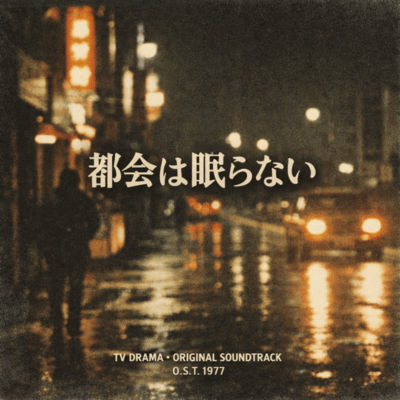
The City Never Sleeps


Track List


Release Date: 2025/12/27
※ Preview may take some time.
※ Preview is not available for songs under copyright collective.
The City Never Sleeps (Original Soundtrack)
The city is never truly quiet at night.
Neon lights flicker, engines fade into the distance,
and unnamed lives leave their traces on rain-soaked streets.
The City Never Sleeps presents a selection of original instrumental compositions
produced for a Japanese television drama aired in 1977.
These pieces do not attempt to explain emotion.
They simply exist within it, moving alongside the story rather than leading it.
Guitars, electric piano, and restrained rhythm sections
create understated portraits of people who belong neither to victory nor defeat,
but to the long hours between dusk and dawn.
The music follows motion rather than action,
silence rather than dialogue.
There is no spoken reason to keep driving.
One moves through the night because the city allows it,
because morning has not yet arrived.
Within that quiet movement, life confirms itself without words.
This soundtrack is not merely background music.
It functions as another presence within the drama,
sharing the same streets, the same nights, and the same unanswered questions.
And even after the final note fades,
the city continues to remain awake, somewhere in the dark.


Share this Page
SNS


Copy URL
https://linkco.re/1uArP4rxCopy Embed Code
<iframe src=https://linkco.re/embed/1uArP4rx width="300" height="600" frameborder="0"></iframe>