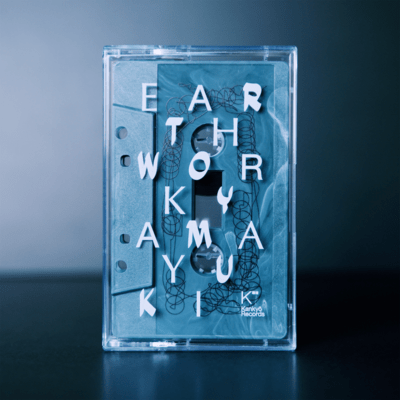
Earthwork


Track List


Release Date: 2025/05/31
※ Preview may take some time.
※ Preview is not available for songs under copyright collective.
"Earthwork" was created by Tokyo-based composer and sound assembler Yama Yuki as an exploration of the possibilities of "kankō ongaku" (literally "tourism music") in the present day. The work both responds to and inherits the lineage of the concept first proposed by Haruomi Hosono in 1985.
Though a fictional concept, "kankō ongaku" resonates deeply with the real world. It was a term applied exclusively to four releases on Monad Records, a label founded by Hosono himself. While encompassing elements of environmental music, ambient, Fourth World music, new age, world music, electronic, and experimental sounds, "kankō ongaku" resists reduction to any single genre. In contrast to the upward-aspiring transcendence of new age music, "kankō ongaku" listens downward-to the earth-touching on the memory of place and transforming the familiar into the unfamiliar.
In Earthwork, Yama Yuki unrolls the unfinished map of "kankō ongaku", dissolves the boundaries of self, and leaps into an ever-shifting stream of sensations-inviting the listener on a journey to a place that is nowhere in particular. The album opens with "Planetary Drone", cloaked in a veil of exotic ambience, and quietly weaves a delicate, vividly colored sonic landscape, with soft tones melting into the surrounding space.
Passing through the gently pulsing sounds of "Nature Nova", as if pausing for breath amidst the sway of flora from a new world, the listener encounters polyrhythms that shimmer like the bioluminescence of some endearing and strange lifeforms. As time progresses, memories and emotions accumulate in layered strata, resonating with the cycles of the earth. In the final track, "Earth Phase, these sounds seem to take root quietly within the listener's inner world.
Fragments of sound, like the echoes of a foreign land, intertwined with subtle humor and spaciousness, gently resound deep in the ear-quietly drawing out what lies beyond the unfinished map of "kankō ongaku". [GRRRDEN]
Latest Playlist In
Natureza Nova
 Spotify • Japanese Ambient/New Age/Kankyo Ongaku (環境音楽)
The Sedimentation of the Mind
Spotify • Japanese Ambient/New Age/Kankyo Ongaku (環境音楽)Maritime Roads
Spotify • Japanese Ambient/New Age/Kankyo Ongaku (環境音楽)Past Rank In
Earthwork
 Apple Music • Electronic Top Albums • Latvia • TOP 9 • 8 Jan 2026
Apple Music • Electronic Top Albums • Netherlands • TOP 96 • 19 Jun 2025
Apple Music • Electronic Top Albums • Taiwan • TOP 104 • 10 Nov 2025
Apple Music • Electronic Top Albums • Singapore • TOP 109 • 2 Jun 2025
Apple Music • Electronic Top Albums • Latvia • TOP 9 • 8 Jan 2026
Apple Music • Electronic Top Albums • Netherlands • TOP 96 • 19 Jun 2025
Apple Music • Electronic Top Albums • Taiwan • TOP 104 • 10 Nov 2025
Apple Music • Electronic Top Albums • Singapore • TOP 109 • 2 Jun 2025Share this Page
SNS


Copy URL
https://linkco.re/c49b4XHHCopy Embed Code
<iframe src=https://linkco.re/embed/c49b4XHH width="300" height="600" frameborder="0"></iframe>