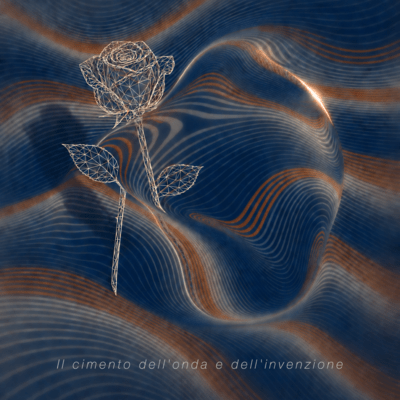
Il cimento dell'onda e dell'invenzione


Music available for YouTube Shorts
×

Track List


Release Date: 2026/09/26
※ Preview may take some time.
※ Preview is not available for songs under copyright collective.
"Il cimento dell'onda e dell'invenzione" is a work born from a series of doubts surrounding contemporary creative practice.
The capitalization of creation, the expansion of expression and diffusion of authorship brought about by generative AI, and the divergence from conventional value judgments that may arise as perception and sensitivity become increasingly acute. Though distinct in nature, each of these issues unsettles the grounds on which value in creative practice is established, leading to two questions: what constitutes artistic value, and what constitutes technical value? Reaching a wider audience, making previously impossible forms of expression possible, and perceiving and controlling ever finer distinctions each possess value in themselves. Yet the degree to which these capacities are developed does not correspond unconditionally to success in either art or technique. This discrepancy is an important consideration for many who create, and it is from this point that the work re-examines what art and technique mean to us.
To address these two questions, art and technique first had to be treated independently. Integrating them under a single principle of creation would not only produce mutual interference, but would also allow the very process of integration to disturb their evaluation. Under such conditions, the success of either could no longer be judged independently. For this reason, the work pursues them separately.
On the artistic side, the question is not merely what to add, but what to choose, what to remove, and what to leave behind. Distancing itself from external evaluation and established systems of value, the work gives primacy to the thought and judgment through which the work itself takes form.
On the technical side, the inquiry leaves behind musical units such as melody and rhythm and shifts its viewpoint down to the signal itself. Its scope begins with scanning signals in terms of amplitude, frequency, and phase, and extends to how far each of these quantities can be controlled as a function. Technical completion in signal processing consists in precision of control and structural coherence, unconstrained by discipline-specific methodologies.
How far can thought and judgment be refined as art? How far can signal and control be refined as technique? The work pursues these questions in parallel, without allowing one to reinforce the other or subsuming both within a single system of value. What is received from the work, and how it is consumed, are left to the listener. For the author, however, what ultimately allowed the work to take form was not any individual conclusion, but the trace of thought that led to it. By questioning art and technique independently, moving repeatedly between thought and production, and accumulating judgments capable of withstanding the demands of both, the process itself came to be accepted as an act of creation. It is at that point that this work was considered complete.
Artist Profile
inariinori
inariinoriの他のリリース


Share this Page
SNS


Copy URL
https://linkco.re/vzMV9z07Copy Embed Code
<iframe src=https://linkco.re/embed/vzMV9z07 width="300" height="600" frameborder="0"></iframe>