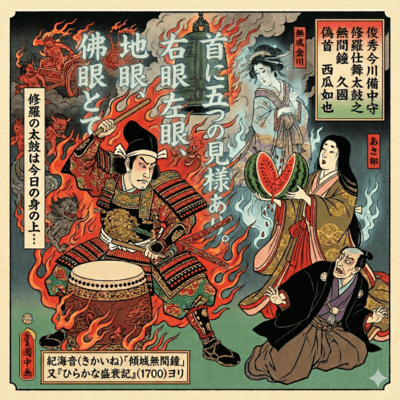
Toshihide Imagawa Bitchu-no-kami Gozen Shura Shimai-daiko Mugen no Kane Hisakuni Nisekubi Suika no Gotoki Nari


Track List


※ Preview may take some time.
※ Preview is not available for songs under copyright collective.
Inspired by Kikai's "Keisei Mugen no Kane" (The Bell of the Courtesan's Inferno), from the kabuki play "Hiragana Seisui-ki" (1700)
Synopsis
"Keisei Mugen no Kane" (The Bell of the Courtesan's Inferno) is a Joruri and Kabuki play from the Edo period. Based on the legend of the "Inferno Bell" from Enshu (Shizuoka) (where striking the bell would bring wealth in this life but send one to hell in the next), this play is famous for its famous scene (the bell in the hand-washing basin) depicting the tragic love and emotions of a courtesan (high-class courtesan) who is prepared to go to hell for the man she loves as she tries to raise money.
Written by Kikai, it premiered in 1700 at the Otowa-za Theater in Osaka.
The legend, passed down at Kansenji Temple in Higashiyama, Kakegawa City, says that striking the bell will bring wealth in this life but send one to hell in the next.
Artist Profile
Sampling 8-1-0
CORT RECORDS / sampling8-1-0 I am a beast. Updates will be a bit slow for a while. All revenue from this channel and other subscriptions will be donated to Weisser Ring. Its a group of people, but there are definitely some tracks where I am actually singing myself Bluuuuu. Only enjoy make Sound Making, Idea, Not all statements, but artworks. There are no plans for promotions or collaborations with anyone. This is a space for my hobbies. I apologize for not connecting it to other platforms, SNS. This does not represent my personal views or those of my workplace. All of them are demos, SSDs? Treasure that looks like trash and not complete packages, but it's up to everyone to listen and practice. The content here is created using programming or AI. However, we have deliberately narrowed the topics to those that are worth creating using DTM. Therefore, the revenue will be donated to the Weisser Ring and National Network Victim Support. The copyrights to these songs are centrally managed by a copyright management organization. For inquiries, please contact grooveon704@gmail.com (For more details, see the Unmanaged Works Ruling System (effective April 2026)) https://www.bunka.go.jp/seisaku/chosakuken/seidokaisetsu/chosakukensha_fumei/tyosakubutsu/index.html
Sampling 8-1-0の他のリリース
 Nenshi Takasago Utai Kotohogi Matsu no Midori Tagasode Nimai Mushi Waku Shita Sampling 8-1-0
 Izumi Nige Rokudo Tsuji Ukiwakare Ai no Mushiriiki Kitano Aibatake Mukau Koori no Tsuitachi Sampling 8-1-0
 Kicking Pillows at Pine Mountain, Hayajiro's Dutiful Rescue of Wankyu / Morning Smoke, The Robe, and Prayers for the Afterlife Sampling 8-1-0
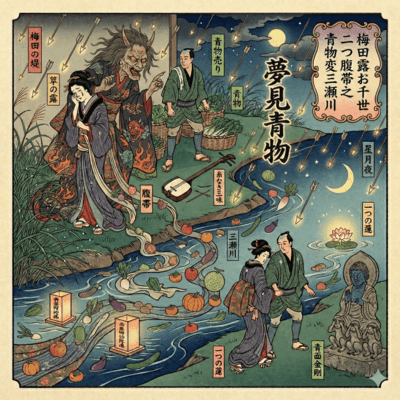 Umeda Dew: Ochiyo's Twin Belts & The Greengrocer's Sanzu River Variation Sampling 8-1-0


Share this Page
SNS


Copy URL
https://linkco.re/03rmXaBTCopy Embed Code
<iframe src=https://linkco.re/embed/03rmXaBT width="300" height="600" frameborder="0"></iframe>