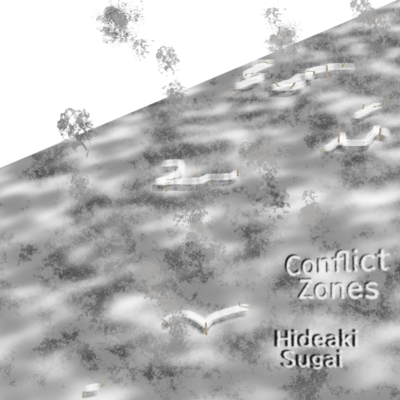
Conflict Zones


Music available for YouTube Shorts
×

Track List


Release Date: 2026/05/08
※ Preview may take some time.
※ Preview is not available for songs under copyright collective.
Hideaki Sugai has released his third album, a progressive metal album that is a total departure from his previous releases, "Music for the Four Seasons" and "The Lighthearted Return of Life." His earlier albums expressed minimalistic Windham Hill-esque melodic lines which were often used as BGM on the internet, but why the sudden switch?
He spent the last two years working on the songs in this album in the belief that music is a means of expression and a medium for conveying what needs to be said. And he has a message about the rising political, economic and military conflicts around the world that have led to the death of innocent civilians. He painted his guitar in the flag colors of a conflict-ridden country, and in live performances, he conveyed his message through his incredible bending and fast playing instead of words to avoid misunderstanding.
Let's take a look at his background. He attended the kindergarten attached to Tohoku Gakuin University, one of the oldest Christian universities in Japan, and sang hymns in church. He says, "Even with songs I'd never heard before, I could predict and sing the second and third verses after hearing the first." When he was seven, his older brother was taking Yamaha Electone lessons and he also joined the class. Because his fingers were too short to play like adults, his teacher taught him composition instead. He recalls, "I learned all the four-note chords and three basic scales." But the class was shut down, so his mother bought him a folk guitar instead.
In junior high, he picked up electric guitar and electric bass as his peers were listening to hard rock and progressive rock. He considers it fortunate that he got to listen to Yes, EL&P, King Crimson, Cream, and Grand Funk during this period. He says, "Back then, everyone played with their hands, and it was great to learn that humans could do such amazing things."
In high school, he joined the brass band where he played the upright bass and learned orchestration. He quit soon after and started a heavy metal band, playing original songs with glam rock makeup. When he did a cover of Misako Honjo, everyone thought his original songs were also by Honjo. This incident shows the quality of his songwriting and playing ability, but it made him decide that he'd never do covers again.
Later, he formed a band with Sanshiro Nishizuka who went on to become a leading street musician in Sendai, but the band broke up for unavoidable reasons. So he bought some home recording equipment which were just coming out, and started recording at home. He produced three albums on cassette tapes, but shared his songs only with his friends. You can see pictures of this period in the Wikipedia entry for 'Home Recording'.
After getting a BA in Philosophy, he obtained a PhD in Linguistics from the University of Hawaii at Manoa. He then worked at several institutions. After the Great East Japan Earthquake, he returned to music to deliver his message to more people. Since then, he has been involved in activities that listeners are familiar with.
While this album is mostly instrumental, listeners can read the message embedded in each track in the song description. The twelve-tone composition technique that he has revealed for the first time on this album is part of a series that will be developed further. He prioritizes expressive methods that align with his message, and doesn't seem to be bound by genre. I look forward to seeing what his future albums will be like.
Artist Profile
Hideaki Sugai
Hideaki Sugai is a Japanese composer and multi-instrumentalist. He was a pioneer of DTM (Desktop Music) in the 1980s. A photo of him from that time is posted on Wikipedia's 'Home Recording' page. He earned a BS in philosophy and a PhD in linguistics, and worked at research institutes and universities, distancing himself from music, but he returned to music after the Great East Japan Earthquake. He composes and performs in a wide range of genres, but 'Music for Four Seasons,' available on Spotify, is a minimalist expression of ECM/Windham Hill-esque melodies, and 'Life's Lighthearted Return' is a similar minimalist expression, but it's surprising that it was created using only Ableton Live Lite, a DAW that anyone can get for free. These two albums have been popular used as UGC of SNS. More than 20,000+ times used. His latest work, 'Conflict Zones,' is structured in a progressive metal style, centering on a guitar sound that blends neoclassical and hard blues techniques-the foundation of his expressive style-to express the depths of humanity. He continues to evolve in songwriting, releasing pieces using the twelve-tone music. Goods (Merch) Kindle books are the goods. "Q&A makes it easy to understand! Introduction to Awa Yamato Yamataikoku Theory" (https://amzn.to/3ZwLX9H) and "How to write a speech manuscript for public speaking Level 1 teaching material - How to master structure, rhetoric, and thinking methods to cultivate wisdom" (https://amzn.to/4ka80eL) are popular. Minimalism and Ambient Music Inspired by the Minimalism: Space. Light. Object. exhibition at the National Gallery Singapore, I started creating a minimal ambient. I revived the song "Kofun" (Tumulus) that I created using only Poly-800 overdubs during my home recording days with modern equipment and used it as an insert song, winning the Excellence Award in the 2018 Tokushima Prefecture Mima City Tourism Promotion Video Contest. You can listen to this song on Bandocamp (https://sugaihideaki.bandcamp.com/track/tumulus-kofun). In 2019, I released "Music for the Four Seasons" (https://www.amazon.co.jp/music/player/albums/B07WTR3GF8). I used this work in an installation with Singaporean artist Ng Pei Ning at the Tokushima Prefectural Museum of Modern Art's "Challenge Tokushima 2020." In 2022, I released "Life's Light and Light Regression" (https://www.amazon.co.jp/music/player/albums/B0BRFLZJL4). It was created using only the free Ableton Live 10 Lite. The track "Nature's Light and Light Regression for TRT" was created based on a research paper on TRT (Tinnitus Retraining Therapy), which is used for patients suffering from tinnitus. During the CoVid-19 Period -Performed live on the distribution site POCOCHA. In order to express inconvenience, I intentionally used a square box without a keyboard. I used a DJ player that plays CDs containing noise, KORG's Volca Bass, KORG sampler KP-3, and Nintendo 3DS (with KORG's M01-D inside). These tunes will be released as 'Dracula, Under Covid Lockdown, started Noise Music' on 13th October 2026. More detailed profile is here: http://sugaihideaki.com/wp/%E7%A7%81%E3%81%AE%E9%9F%B3%E6%A5%BD%E6%AD%B4%E7%95%A5%E6%AD%B4/
Hideaki Sugaiの他のリリース


Sorabito
Share this Page
SNS

Copy URL
https://linkco.re/16CreQEyCopy Embed Code
<iframe src=https://linkco.re/embed/16CreQEy width="300" height="600" frameborder="0"></iframe>