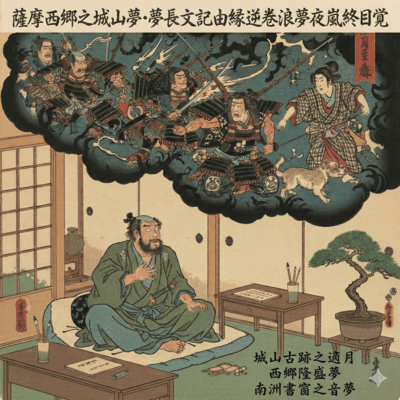
Satsuma Saigo No Shiroyama Yume Yume Chobunki Yuen Sakamakunami Yumenoyoarashi Owari Mezame


Track List


※ Preview may take some time.
※ Preview is not available for songs under copyright collective.
Inspired by Nakajima Ko's "Sakamakuna Mi Yume no Yoarashi" (1888)
Satsuma Saigo's Dream on Shiroyama: A Long Dream Chronicle Originating from the Sakamakuna Mi Yume no Yoarashi Ending Awakening
This work begins immediately after the tense call for postwar cleanup sounds, with a sudden shift to a scene of Saigo waking up in his study, with the words, "Idechinto no. Koi yanachimachi Takamori awaking with a start." It's a highly dramatic scene, with a sudden shift from the intense scenes of war to the quiet study.
Immediately after the brutal climax, in which Saigo commits suicide and the Imperial Army storms into Shiroyama, there is a shocking scene in which Saigo Takamori suddenly wakes up and realizes that the entire war up to that point was "a dream."
This is a story (or a play/joruri-style reading) based on the Seinan War, which took place in 1877 (Meiji 10).
Early Meiji Period (1877)
The story is set in the final days of the Seinan War. As the opening lines state, "The rising sun shining in the eastern sky is the Imperial Army's flag / The starlight setting in the southwest is the soul of a wild man," this is the period in which the story depicts the battle between the government forces (Imperial Army) and Saigo's forces, as well as the final moments of Saigo Takamori and his men (the Battle of Shiroyama).
Excerpts from the actual script:
The Moonlit Moon at the Shiroyama Ruins
Saigo Takamori's Dream
The Sound of a Book Window in Nanshu
I'm going to write down my dream in a long piece.
The Night Storm Ends, the Reverse Wave Dream
The Obligations of the Floating World, Tears in My Eyes, and a Face Turned Upside Down
Flowers, Peeking into the Storm.
A hailstorm of assassins.
Rising black smoke.
A voice: The transience of this world.
Burning incense: Nishiyama Mikasamu, black.
A beautiful travelling figure.
At that time, they called it international exchange.
A nose flying. He puts his hand over his nose.
A nose flying. He puts his hand over his nose.
The Satsuma Lagoon is dazzling.
It's as if the waves are crashing.
Arita Kensuke, with his sense of justice,
is being too stingy.
Looking at his eyes filled with regret, his whole being wracked.
Sengun Nakamura.
He throws his horse into the mud.
He appears, kicking up sand,
beyond the pine trees.
At Tabaruzaka, they advance toward their allied fortifications. Knowing what's ahead, the Osaka garrison let their guard down and launched a coordinated attack. The bullets shattered. A moment passed. The corpses of the officers lay scattered. We hurry to Shiroyama. It's really rubbing. Saigo will not die. The waters are watering. Let's do as we please. The spring waves have calmed down, The shadows of the dead. The splendid Takemoto. Ichiro, and then a little. Frozen. The true flow of Futase and the people. Good, sincere teachings. The high blades blaze through the short night. Out of sight, out of mind.
I, Yanamachi
Saigo Takamori
I suddenly woke up and got up.
Strange, what a dream I just had. I gazed into the garden.
I'm going to write down my dream in length.
The night storm of the rising waves in my dream ended.
Artist Profile
Sampling 8-1-0
CORT RECORDS / sampling8-1-0 I am a beast. Updates will be a bit slow for a while. All revenue from this channel and other subscriptions will be donated to Weisser Ring. Its a group of people, but there are definitely some tracks where I am actually singing myself Bluuuuu. Only enjoy make Sound Making, Idea, Not all statements, but artworks. There are no plans for promotions or collaborations with anyone. This is a space for my hobbies. I apologize for not connecting it to other platforms, SNS. This does not represent my personal views or those of my workplace. All of them are demos, SSDs? Treasure that looks like trash and not complete packages, but it's up to everyone to listen and practice. The content here is created using programming or AI. However, we have deliberately narrowed the topics to those that are worth creating using DTM. Therefore, the revenue will be donated to the Weisser Ring and National Network Victim Support. The copyrights to these songs are centrally managed by a copyright management organization. For inquiries, please contact grooveon704@gmail.com (For more details, see the Unmanaged Works Ruling System (effective April 2026)) https://www.bunka.go.jp/seisaku/chosakuken/seidokaisetsu/chosakukensha_fumei/tyosakubutsu/index.html
Sampling 8-1-0の他のリリース
 Tokihazure Kono Shinmotsu No Sakai Donsu Hiyokujima Irohauta No Kabuto Sampling 8-1-0
 Goshu Tagahomare Mie Kiyomigasekisho No Karahashi Sakuju Sampling 8-1-0
 Zensho Dokuro Kumano Koboku Kozue Yurai No Sanjusangendo Munagi Naori Torime Sampling 8-1-0
 Nisegane Kanman Hikyaku Oogatari Manuke Nakauri Kanzo Okui No Chikagoro Tatsutagawa Hiki Sampling 8-1-0


COAT RECORDS.
Share this Page
SNS


Copy URL
https://linkco.re/VeS7eQ0xCopy Embed Code
<iframe src=https://linkco.re/embed/VeS7eQ0x width="300" height="600" frameborder="0"></iframe>