[Intro]
(しろい せかい。なにも ない。)
「これは なんですか。」
[Verse 1]
「これは ほんです。」
…ほん! しろい せかいに、ほん。
「それは じしょです。あれは ざっしです。」
しんぶん、ノート、てちょう、めいし、カード。
「これは なんですか。」「えんぴつです。」
「それは?」「ボールペンです。」「あれは?」「シャープペンシルです。」
[Verse 2]
「この かぎは だれのですか。」「アキさんのです。」
「その とけいは?」「ツムギさんのです。」
「あの かさは?」「…だれのですか。」
かばん、ネクタイ、CD、テレビ、ラジオ、カメラ、コンピューター。
くるま、つくえ、いす。
(しろい せかい。もの、もの、もの。)
[Chorus]
ことばは ちから ことばは ひかり
これは ほん。それは とけい。あれは あなた。
ことだま ことだま
「これは なんですか。」「それは ことばです。」
[Verse 3]
「ここは どこですか。」「ここは きょうしつです。」
「そこは?」「しょくどうです。」「あそこは?」「じむしょです。」
かいぎしつ、うけつけ、ロビー、へや、トイレ。
かいだん、エレベーター、エスカレーター。
「でんわは どこですか。」「あそこです。」
「じどうはんばいきは?」「ちかです。」「かいしゃは?」「あそこです。」
「くつうりばは なんがいですか。」「にかいです。」
[Bridge]
「これは いくらですか。」「ひゃくえんです。」
「この コーヒーは?」「にひゃくえん。」「この チョコレートは?」「せんえん。」「この くるまは?」「ひゃくまんえん。」
「この カメラは どこの カメラですか。」「にほんの カメラです。」
「この とけいは?」「スイスの とけいです。」
「この ワインは?」「フランスの ワインです。」「この くつは?」「イタリアの くつです。」
「ツムギさん、おくには?」
「…ことばの くにです。」
[Final Chorus]
ことばは ちから ことばは ひかり
これは ほん。それは とけい。あれは あなた。
ことだま ことだま
しろい せかいは、ことばの せかい。
[Outro]
(しろい せかいに、もの。もの。もの。)
えいごの ほん。にほんごの ほん。
「アキさんの うちは どこですか。」「アメリカです。」
「おみやげは?」「…ことばです。」
- Lyricist
KYOKASHO RECORDS
- Composer
KYOKASHO RECORDS
- Producer
KYOKASHO RECORDS
- Programming
KYOKASHO RECORDS
Listen to Kore wa Nan desu ka by KYOKASHO RECORDS
Streaming / Download
- 1
Hajimemashite
KYOKASHO RECORDS
- ⚫︎
Kore wa Nan desu ka
KYOKASHO RECORDS
- 3
Jikan ga Ugoku
KYOKASHO RECORDS
- 4
Itadakimasu
KYOKASHO RECORDS
- 5
Suki desu
KYOKASHO RECORDS
- 6
Neko ga Imasu
KYOKASHO RECORDS
- 7
Hoshii, Hoshii
KYOKASHO RECORDS
- 8
Tsunaide
KYOKASHO RECORDS
- 9
Daijobu
KYOKASHO RECORDS
- 10
Dekiru Koto
KYOKASHO RECORDS
- 11
Futsu no Yoru
KYOKASHO RECORDS
- 12
Moshi Mata Aetara
KYOKASHO RECORDS
- 13
Sentanbun - Jo - 1
KYOKASHO RECORDS
- 14
Sentanbun - Ge - 2
KYOKASHO RECORDS

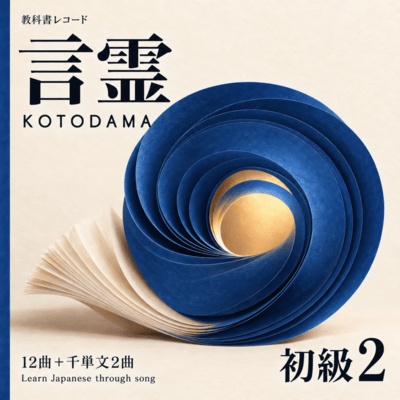
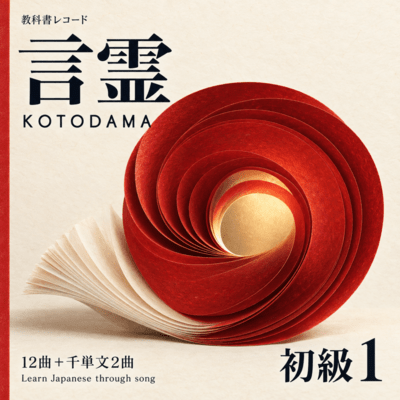
KOTODAMA - Learn Japanese by Song
An album where every word and grammar point from the beginner Japanese textbook "Minna no Nihongo I" becomes a lyric. A textbook-based Japanese song collection made for anyone learning the language.
Twelve songs spanning Lessons 1 through 25. The story follows Aki, a boy from America, and Tsumugi, the girl who teaches him words one at a time. In an empty white world, verbs are born, then desires, then feelings, and finally, in the te-form and tara-form, a promise between two people. No kanji is used anywhere - each song is built only from the vocabulary taught up to its corresponding lesson.
In Track 11, formal speech gives way to plain form for the first time, staged as the moment the two characters grow closer. In Track 12, on the day of departure, the "hajimemashite" of Track 1 returns once more - this time through tears.
Full lyrics, romaji, English translations, and textbook cross-references (2nd and 3rd editions) are free at:
https://kuralab.fun/kotodama
KYOKASHO RECORDS - turning textbooks into music.